Walk into almost any modern manufacturing facility today, and you will likely find an AI initiative already underway.
It could be a predictive maintenance experiment on a production line, a computer vision system inspecting product quality, or an AI assistant connected to enterprise systems.
But there is one common challenge across many manufacturing organisations:
The challenge is not whether AI technology works. AI pilots are increasing, but very few are successfully scaling beyond the initial experiment.
The challenge is whether the organisation is ready to implement AI at scale.
Successful AI transformation in manufacturing requires more than deploying a model or running a proof of concept. It requires connected data, integrated systems, skilled teams, clear governance and a roadmap aligned with business objectives.
Without understanding the current maturity level of your organisation, every AI project becomes another isolated experiment.
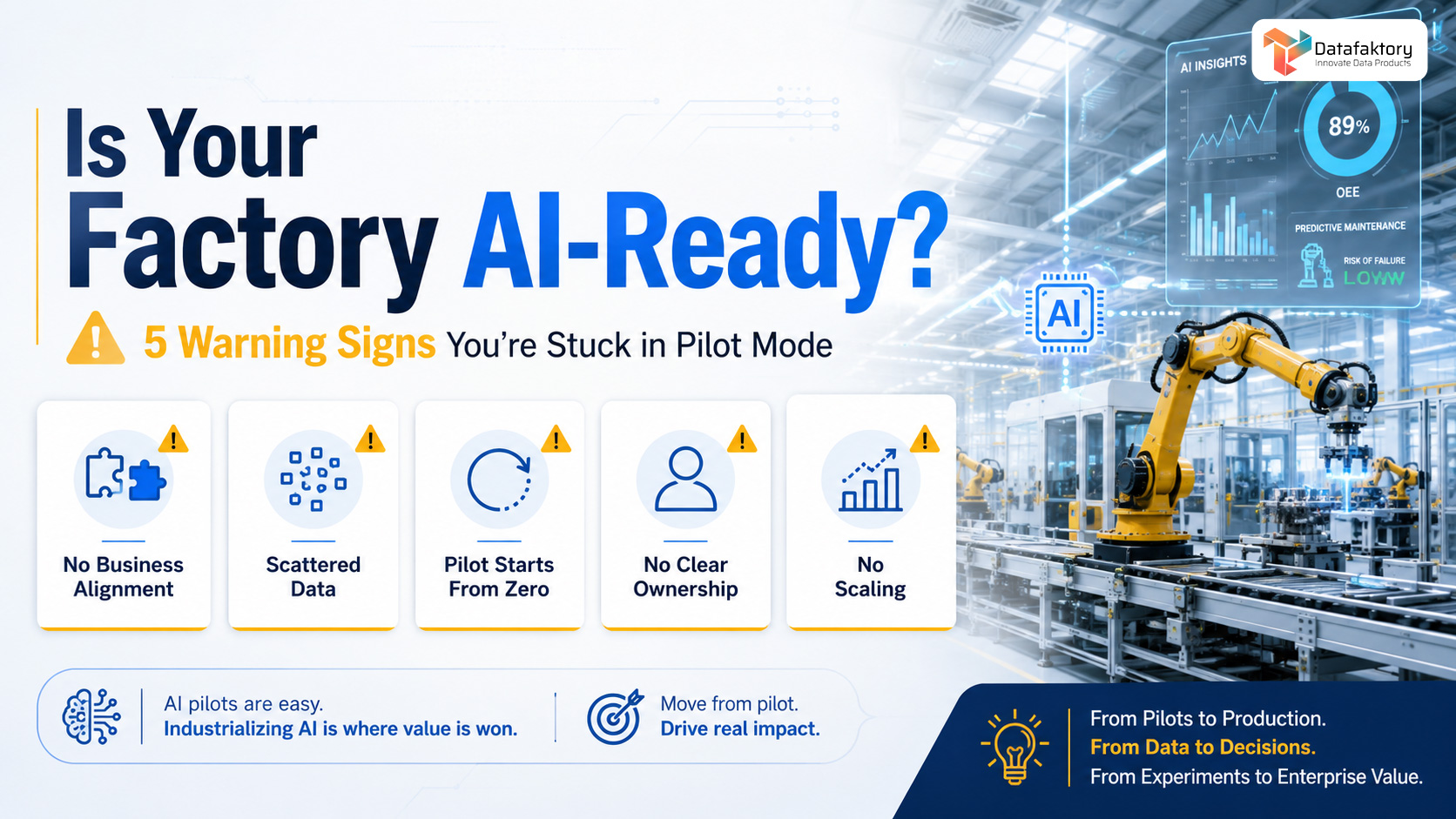
So, how can you identify whether your factory is AI-ready or still stuck in pilot mode?
Here are five warning signs.
1. Every AI Use Case StartsfromZero
One of the biggest indicators of low AI maturity is when every new AI project requires completely new infrastructure.
A new pilot needs:
- Fresh data extraction
- New system integrations
- Separate technology environments
- Custom development efforts
This approach creates individual experiments instead of building an enterprise AI capability.
A mature industrial AI strategy allows organisations to reuse their data foundation, technology architecture and AI frameworks across multiple use cases.
The second AI project should be faster and more cost-effective than the first.
If every project feels like starting from scratch, your organisation may need a stronger AI readiness foundation.
2. Nobody Owns the AI Outcome
Many AI pilots begin with a passionate internal champion — a plant manager, data scientist, innovation team or external consultant.
However, when ownership is unclear, projects often lose momentum after the initial phase.
Scaling AI requires clear accountability across:
- Data ownership
- Business outcomes
- Technology implementation
- Operational adoption
- Continuous improvement
Without proper AI governance, organisations struggle to move from experimentation to operational impact.
A successful AI maturity assessment helps identify gaps in ownership, decision-making structures and governance models required for sustainable AI adoption.
3. IT and OT Systems Are Still Disconnected
Manufacturing organisations operate across two critical environments:
- Information Technology (IT) — enterprise applications, ERP systems and business data.
- Operational Technology (OT) — machines, sensors, production systems and industrial equipment.
When these environments operate separately, scaling AI becomes challenging.
AI use cases such as:
- Predictive maintenance
- Production optimisation
- Quality prediction
- Real-time process monitoring
require seamless data flow between machines, production systems and enterprise platforms.
If connecting one machine to an analytics dashboard requires weeks of manual effort, your organisation is not yet prepared for scalable smart manufacturing solutions.
4. Data Quality Issues Are Known but Not Measured
Almost every manufacturing leader understands that data quality is a challenge.
However, knowing that data is unreliable is different from understanding:
- Which data sources are affected?
- How accurate is the information?
- Where are the biggest gaps?
- What impact does poor data have on operations?
AI systems depend on trustworthy data.
Poor-quality industrial data leads to inaccurate predictions, unreliable recommendations, and limited trust from decision-makers.
Before implementing advanced AI solutions, organisations need a clear understanding of their manufacturing data readiness.
A structured maturity assessment helps identify data gaps and prioritise improvements.
5. Investment Continues Going into Pilots Instead of Platforms
Another sign of pilot mode is when organisations continuously fund individual AI projects but do not invest in the foundations required to scale.
Successful AI adoption requires investment in:
- Data platforms
- Integration capabilities
- AI governance
- Model deployment processes
- Employee skills
Without these shared capabilities, organisations continue repeating the same cycle:
Pilot → Test → Stop → Restart
The goal of AI transformation is not to create more pilots.
The goal is to build a scalable AI ecosystem that continuously improves business performance.
Why Manufacturing Organisations Get Stuck in Pilot Mode
The transition from AI experimentation to enterprise adoption requires a clear understanding of current capabilities.
Many organisations move directly from:
“Let’s explore AI”
to
“Let’s implement AI”
without evaluating their maturity across:
- Data
- Technology
- People
- Processes
- Governance
Without a baseline, AI strategy becomes guesswork.
A structured Industry 4.0 maturity assessment provides organisations with a clear view of where they currently stand and what steps are required to scale AI successfully.
How Can Manufacturers Move Beyond AI Pilot Mode?
The first step is understanding your current AI readiness level.
A comprehensive maturity assessment should help answer:
- Is our data ready for AI applications?
- Are our IT and OT systems connected?
- Do we have the right governance structure?
- Are our teams prepared for AI adoption?
- Which AI use cases should be prioritised?
Ready to Assess Your AI Readiness?
Moving beyond AI pilots requires a clear understanding of where your organisation stands today and what capabilities are needed to scale successfully.
DataFaktory’s AIMRI (Industry Maturity Assessment) helps manufacturing organisations evaluate their AI and data readiness across key transformation areas, identify maturity gaps and build a practical roadmap toward scalable AI adoption.
Whether you are starting your AI journey or looking to scale existing initiatives, understanding your current maturity is the first step toward building a future-ready manufacturing ecosystem.
Contact us to assess your organisation’s AI readiness and discover how you can move from isolated AI experiments to measurable business impact.