Unexpected equipment failure can disrupt production, increase maintenance expenses, and delay customer deliveries. Predictive maintenance AI helps industrial businesses address this challenge by identifying early warning signs before a machine fails.
Unlike preventive maintenance, which follows a fixed service schedule, predictive maintenance uses real-time and historical data to estimate when equipment is likely to require attention. This enables maintenance teams to intervene at the right time—before a costly breakdown occurs and without performing unnecessary maintenance.
How Does Predictive Maintenance AI Work?
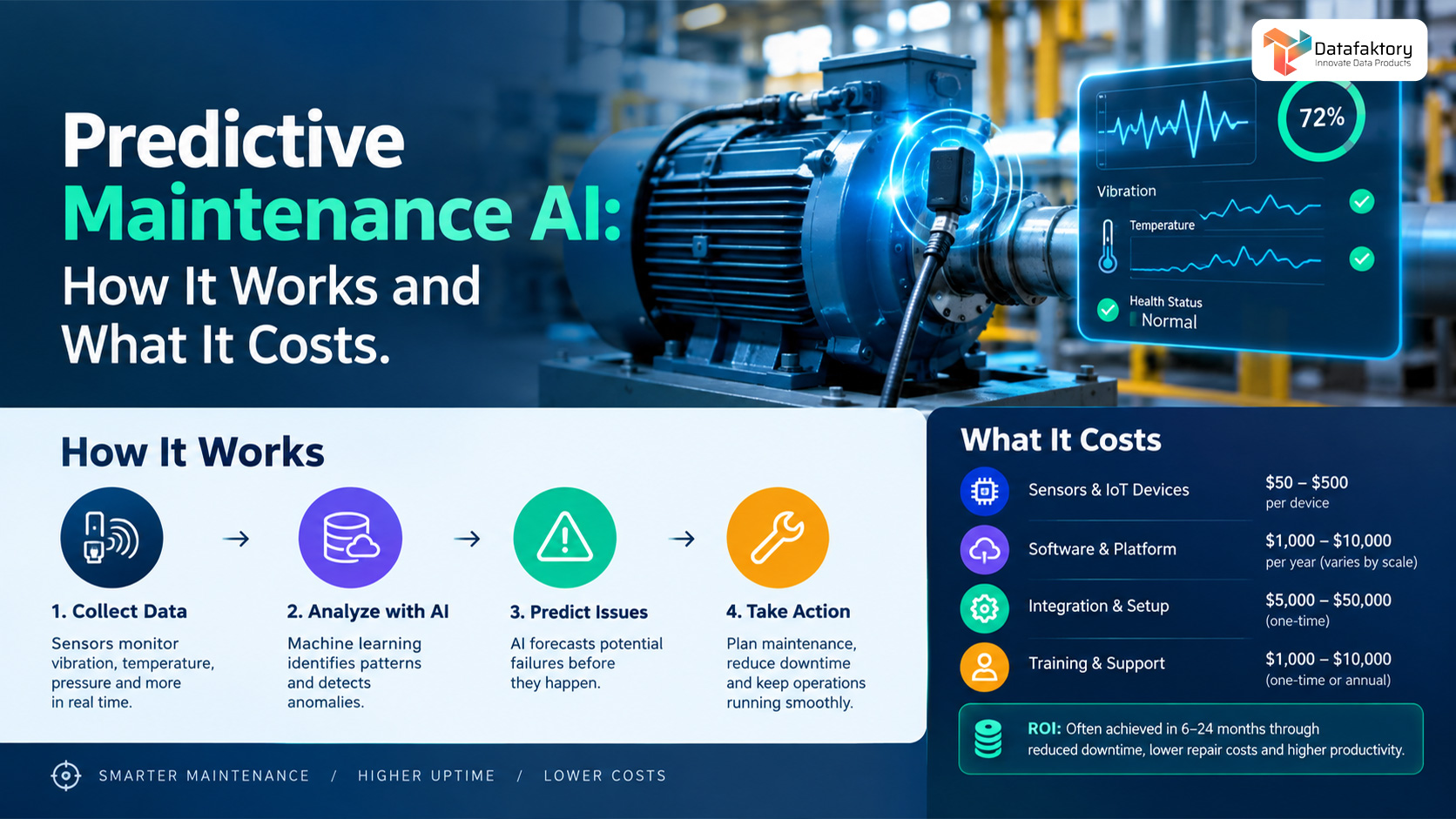
Predictive maintenance AI combines machine data, sensors, data engineering, and machine learning to monitor equipment health. The process generally includes five stages:
1. Collecting Equipment Data
Sensors and existing industrial systems collect information such as vibration, temperature, pressure, sound, energy consumption, and operating speed. Data may also come from maintenance records, ERP platforms, manufacturing execution systems, and machine logs.
2. Creating a Reliable Data Foundation
The collected data must be cleaned, structured, and integrated before it can support an AI model. Missing information, inconsistent formats, and disconnected operational systems can reduce prediction accuracy. A trusted data foundation is therefore essential for scaling predictive maintenance beyond an isolated pilot.
3. Identifying Normal Operating Patterns
Machine learning models analyse historical performance to understand how equipment behaves under normal conditions. The models can then identify patterns or anomalies that may indicate wear, declining performance, or an emerging fault.
4. Predicting Potential Failures
When the system detects unusual behaviour, it can estimate the probability of failure or calculate the equipment’s remaining useful life. Maintenance teams may receive an alert identifying the affected machine, the likely issue, and the recommended inspection timeframe.
5. Improving the Model Continuously
The AI model becomes more useful as it processes additional operating data and maintenance outcomes. Feedback from technicians can help refine predictions, reduce false alerts, and improve decision-making over time.
What Does Predictive Maintenance AI Cost?
There is no universal price because the cost depends on equipment complexity, data availability, integration requirements and the number of assets being monitored.
The cost of predictive maintenance AI varies significantly depending on the number and type of assets, existing sensor coverage, data quality, integration requirements, deployment model and level of customisation. Expenses may include sensors, connectivity, data infrastructure, AI model development, system integration, dashboards, training and ongoing support. A focused proof of concept will generally require less investment than a multi-site production deployment, but an accurate budget can only be established after assessing the organisation’s equipment, data readiness and business objectives.
The main cost components include:
- Sensors and connectivity infrastructure
- Data collection and storage
- Integration with ERP, MES, SCADA or maintenance systems
- AI model development and validation
- Dashboards, alerts and workflow automation
- Cloud or edge-computing infrastructure
- Ongoing monitoring, support and model improvement
These figures should be treated as indicative estimates. Organisations with connected equipment and reliable historical data may require less initial investment than businesses starting with fragmented or manually recorded information.
Is Predictive Maintenance AI Worth the Investment?
The value of predictive maintenance should be assessed against the cost of unplanned downtime, emergency repairs, lost production, product-quality issues and inefficient spare-parts management.
The strongest approach is usually to begin with a high-value asset or recurring failure scenario where the operational and financial impact can be measured clearly. Once the use case proves its value, the solution can be expanded across other machines, lines or facilities.
Datafaktory helps industrial organisations connect operational data, build trusted AI-ready foundations and develop scalable smart factory solutions, including predictive maintenance and real-time production analytics. Its approach focuses on moving AI initiatives from isolated pilots to measurable, production-ready capabilities. Learn more about DataFaktory.
Ready to reduce unplanned downtime and improve equipment performance? Contact Datafaktory to discuss a predictive maintenance AI solution designed around your operations.