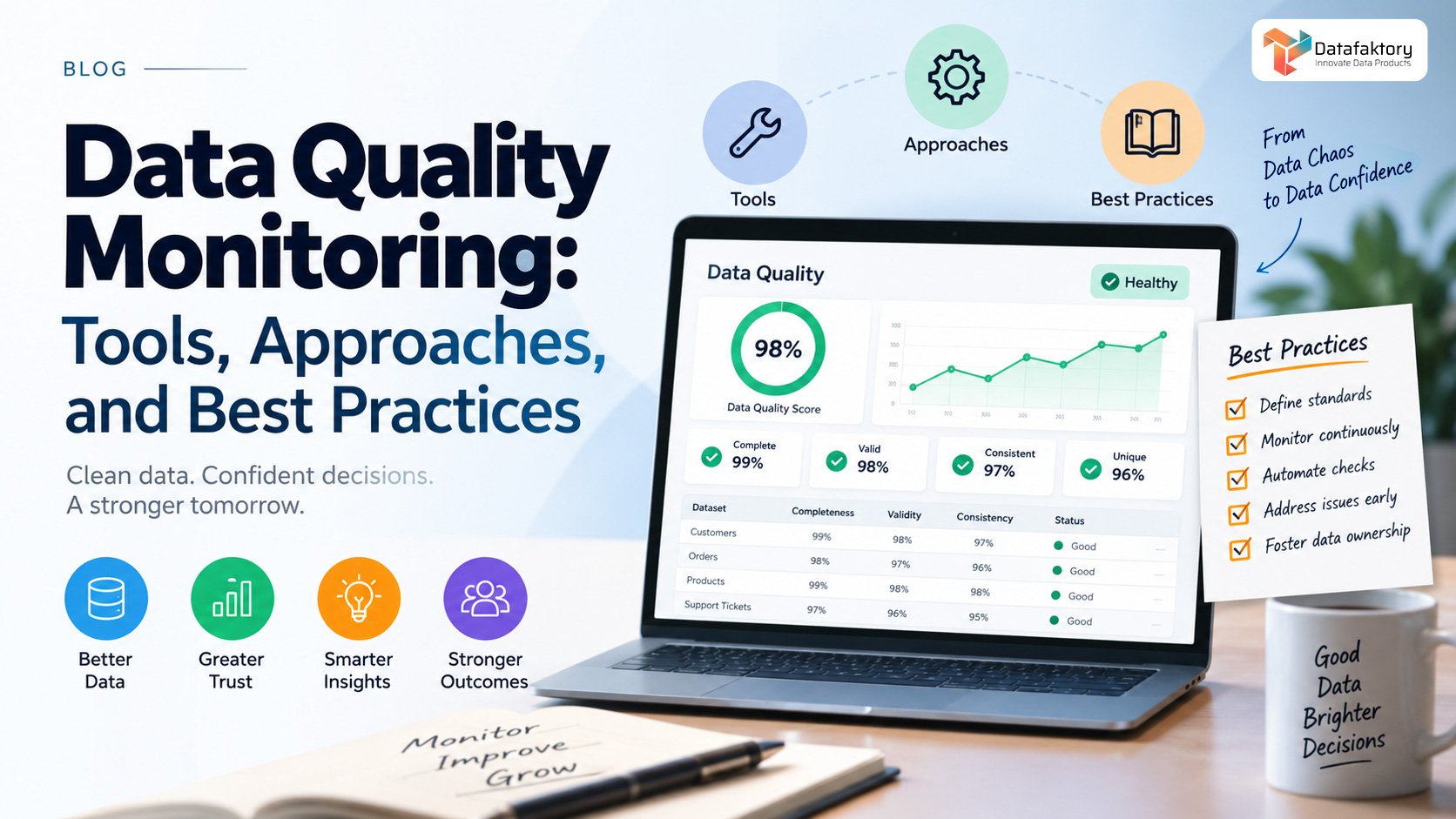
Data quality monitoring is the continuous process of measuring, detecting, and resolving data issues across databases, applications, pipelines, dashboards, and AI systems. It helps organisations ensure their data remains accurate, complete, consistent, timely, valid, and unique.
For businesses building AI-ready data foundations, data quality monitoring is not merely a technical activity. It is essential for reliable analytics, scalable automation, regulatory compliance, and confident decision-making.
Why Is Data Quality Monitoring Important?
Poor-quality data can produce inaccurate reports, inefficient operations, unreliable AI outputs, compliance risks, and lost business opportunities. In industrial environments, inconsistent machine or production data may also affect predictive maintenance, quality control, supply-chain planning, and operational performance.
Continuous monitoring enables organisations to detect problems before they spread across connected systems. It also makes it easier to identify the source of an issue, understand its business impact, and assign responsibility for resolving it.
The six primary dimensions of data quality are:
- Accuracy: Does the data correctly represent the real-world object or event?
- Completeness: Are all mandatory values available?
- Consistency: Does the information match across different systems?
- Timeliness: Is the data current and available when required?
- Validity: Does it follow defined formats and business rules?
- Uniqueness: Are duplicate records being identified and prevented?
Types of Data Quality Monitoring Tools
Data quality monitoring tools automate data profiling, validation, anomaly detection, alerting, reporting, and root-cause analysis. Common tool categories include:
1. Rule-Based Validation Tools
These tools compare data against predefined technical and business rules. For example, every production order may require a valid product code, timestamp, quantity, and manufacturing location.
2. Data Observability Platforms
Data observability platforms monitor pipeline health, schema changes, data freshness, volumes, lineage, and unexpected failures. They help teams determine where an issue originated and which downstream systems may be affected.
3. AI-Powered Anomaly Detection
AI-powered monitoring identifies unusual changes by learning normal data patterns. It is particularly useful when organisations manage large, complex, or rapidly changing datasets that cannot be monitored through manual rules alone.
4. Data Quality Dashboards
Dashboards give business and technical stakeholders a shared view of quality scores, missing values, duplicate records, failed rules, incident trends, and resolution status.
What Is the Best Data Quality Monitoring Approach?
The most effective approach combines rule-based validation, automated anomaly detection, data observability, and clearly defined ownership.
Monitoring should be implemented throughout the data lifecycle:
- Validate data when it enters the organisation.
- Monitor transformations within data pipelines.
- Test data before it reaches reports or AI models.
- Track quality trends through dashboards.
- Alert the responsible team when agreed thresholds are breached.
This layered approach prevents organisations from discovering quality issues only after a dashboard, operational process, or AI system has already been affected.
Data Quality Monitoring Best Practices
To build a sustainable monitoring framework, organisations should:
- Prioritise data that affects customers, revenue, compliance, or operations.
- Establish measurable thresholds for critical data elements.
- Assign accountable data owners and data stewards.
- Connect technical alerts to measurable business impact.
- Avoid excessive notifications by defining severity levels.
- Document the causes and resolutions of recurring incidents.
- Review quality rules as systems and requirements evolve.
- Integrate monitoring with data governance and AI governance.
The right monitoring framework should also work with an organisation’s existing technology ecosystem. Instead of treating data quality as a separate initiative, businesses should embed validation and monitoring into operational systems, cloud platforms, data pipelines, and analytics workflows.
Build a Trusted Data Foundation with Datafaktory
Reliable AI, analytics, and automation begin with data that organisations can trust. Datafaktory helps enterprises assess their data maturity, establish scalable data foundations, integrate fragmented systems, and develop production-ready AI and data capabilities.
Contact Datafaktory today to discuss how data quality monitoring can strengthen your data, analytics, and AI initiatives.