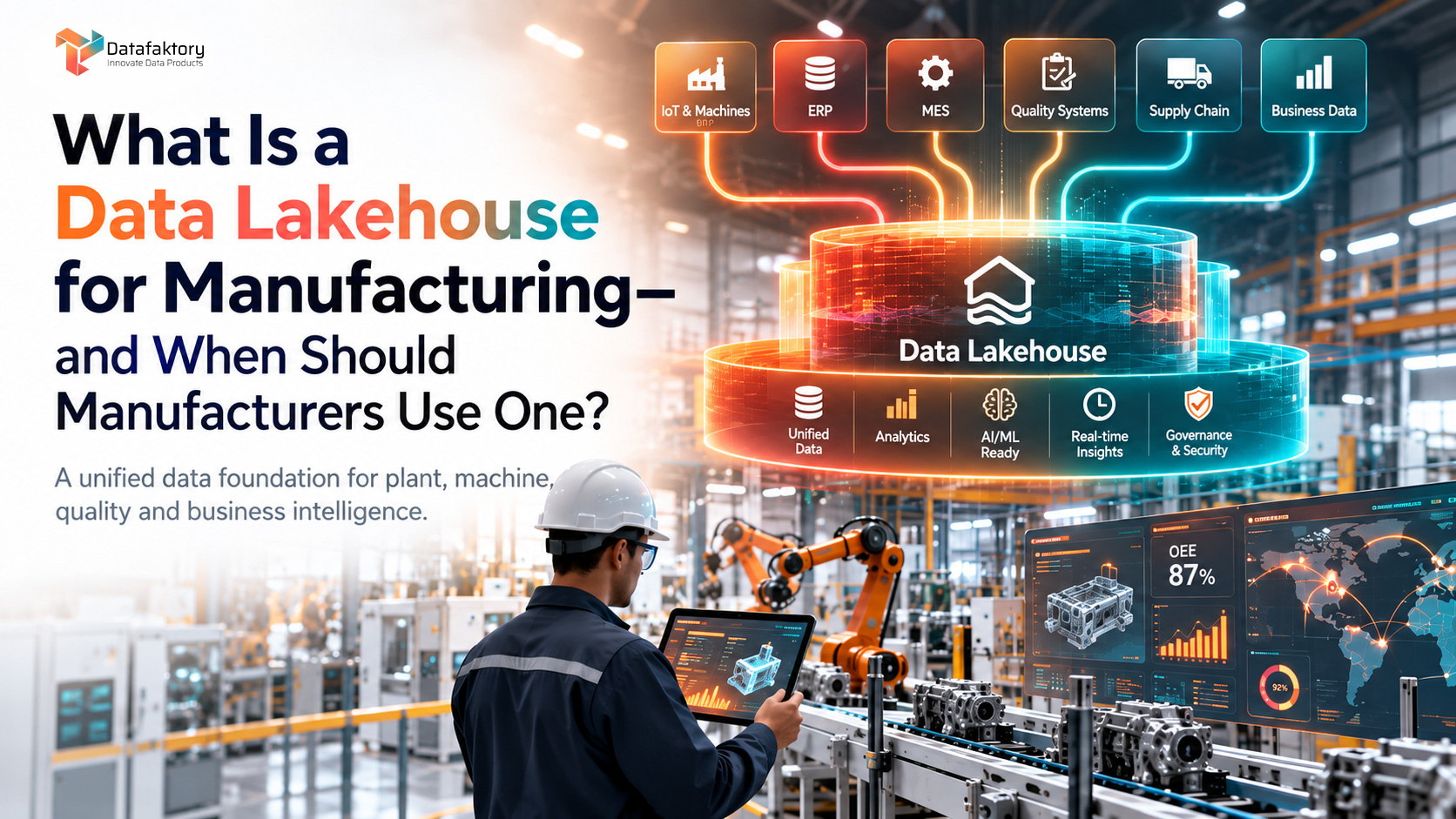
Manufacturers generate enormous amounts of information across production lines, MES platforms, ERP systems, machines, sensors, quality systems, and maintenance applications.
A data lakehouse for manufacturing can bring these fragmented sources together within a governed data foundation for analytics, AI, predictive maintenance, digital twins, and operational decision-making.
But not every manufacturer needs one.
The real question is not whether a lakehouse is modern technology.
It is whether fragmented data is preventing better business and operational decisions.
What Is a Data Lakehouse?
A data lakehouse is a data architecture that combines the flexible storage capabilities of a data lake with the governance, reliability, and analytical capabilities associated with a data warehouse.
For manufacturers, this means structured business data from ERP systems can be analysed alongside semi-structured and unstructured information from MES, SCADA, PLCs, IoT sensors, maintenance systems, quality platforms, documents and other industrial sources.
A well-designed manufacturing data lakehouse can provide a common foundation for business intelligence, operational analytics, machine learning, industrial AI, streaming data and digital twins.
The objective is not simply to store more information.
It is to make industrial data easier to trust, combine, and reuse.
Data Lake vs Data Warehouse vs Data Lakehouse for Manufacturing
The easiest way to understand a lakehouse is to compare what each architecture is designed to do.
| Capability | Data Warehouse | Data Lake | Data Lakehouse |
| Primary purpose | BI and structured reporting | Large-scale flexible data storage | BI, analytics, AI and ML |
| Structured data | Excellent | Supported | Excellent |
| Semi-structured data | Platform dependent | Excellent | Excellent |
| Unstructured data | More limited | Excellent | Excellent |
| Governance | Typically strong | Varies | Strong when properly designed |
| SQL analytics | Excellent | Often requires additional layers | Strong |
| Machine learning | Possible, sometimes with data movement | Strong | Strong |
| Streaming / IoT | Often requires additional architecture | Supported | Supported |
| Manufacturing fit | ERP, finance and standard KPIs | Sensor and raw industrial data | Cross-domain industrial analytics |
A lakehouse does not necessarily replace every warehouse, historian or operational database.
It can become the analytical backbone that connects them.
Why Manufacturing Data Becomes Difficult to Use
Consider a single production machine.
- Its PLC knows the temperature, pressure, and operating speed.
- The MES knows which product and production order are running.
- The maintenance system knows when the machine was last serviced.
- The quality system knows whether the batch passed inspection.
- The ERP knows the order value, inventory position, and financial impact.
- Each system provides useful information independently.
- The greater value appears when those datasets can be analysed together.
Imagine defect rates increasing during one particular shift. Understanding the cause might require correlating machine settings, production speed, material batches, supplier information, maintenance history, shift context, environmental conditions and inspection results.
If that information remains distributed across separate systems, teams can spend more time locating, cleaning and joining data than analysing it.
This problem becomes even more important when manufacturers introduce AI.
Important: In many industrial AI initiatives, the model is not the hardest part. The quality, accessibility, and context of the data underneath it is often the bigger challenge.
Where can a Manufacturing Data Lakehouse Create Value?
A lakehouse does not create value simply by centralising information.
Its value comes from making previously disconnected data usable together.
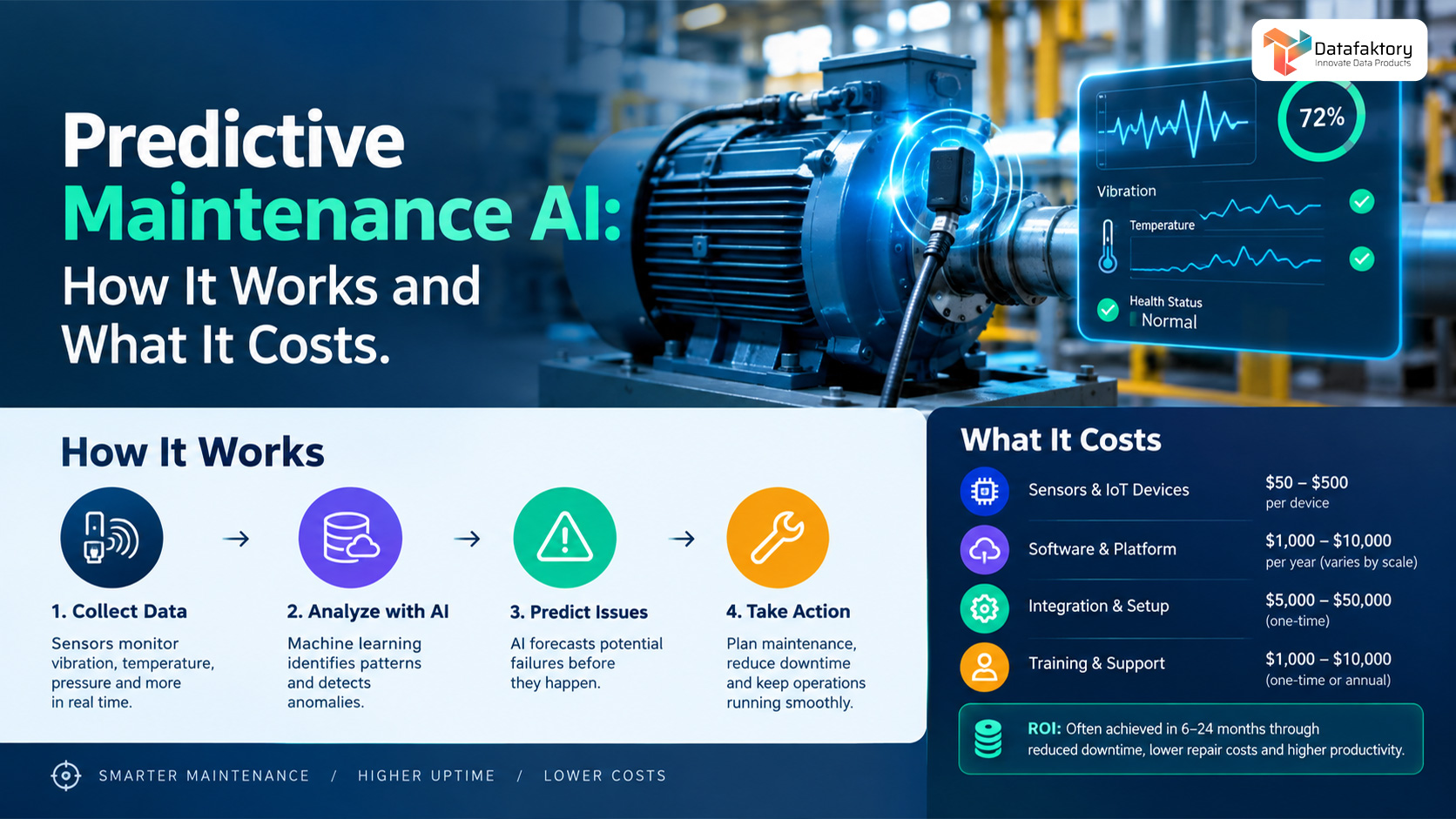
Predictive Maintenance
Predictive maintenance is sometimes presented as a simple process:
Sensor → AI Model → Failure Prediction
Industrial reality is more complex.
An abnormal vibration reading may become meaningful only when combined with equipment age, operating load, temperature, maintenance history, previous failures, component replacements, and current production conditions.
With this context, analytics can move beyond:
“Machine 14 has abnormal vibration.”
toward decision support such as:
“Machine 14 is showing behaviour similar to previous bearing failures and should be inspected during the next suitable maintenance window.”
That is the difference between monitoring equipment and supporting maintenance decisions.
Quality Intelligence
A dashboard may tell a manufacturer that defect rates increased.
The more important question is:
Why?
Suppose defects rise from 1.8% to 4.2%.
The explanation may sit across several systems: material batches, suppliers, machines, tools, recipes, shifts, production speeds, equipment settings, environmental conditions, and inspection measurements.
A connected manufacturing data foundation allows teams to move from asking:
“How many defects occurred?”
to:
“Which combination of process conditions is associated with this defect?”
That is the shift from reporting to operational intelligence.
Digital Twins
Digital twins may appear to be primarily simulation or visualisation technologies.
Their real foundation is reliable, contextualised data.
An industrial digital twin may depend on information from PLCs, IoT devices, MES platforms, ERP systems, maintenance applications and historical production records.
If those inputs are incomplete or inconsistent, the sophistication of the visual model does not solve the underlying problem.
A lakehouse can provide part of the governed historical and operational data foundation required for simulation, analytics and machine-learning workloads.
Industrial AI
Manufacturing AI increasingly needs more than structured ERP tables.
Industrial companies generate machine alarms, maintenance notes, equipment manuals, standard operating procedures, engineering documents, operator comments, quality images, sensor readings, test certificates and supplier documentation.
A lakehouse can make structured and unstructured information available within a more consistent analytical environment.
That creates opportunities for maintenance copilots, quality investigation assistants, operations intelligence, and engineering knowledge systems.
The real advantage is not simply having AI.
It is giving AI access to trusted industrial context.
What Does a Manufacturing Lakehouse Architecture Look Like?
A manufacturer does not need to integrate the entire enterprise on day one.
Conceptually, a practical architecture can be understood in five stages.
| Stage | Purpose | Manufacturing Example |
| Connect | Bring relevant data into the analytical environment | ERP, MES, SCADA, PLC/IoT, QMS, CMMS, CRM and supplier systems |
| Preserve | Retain granular source information and history | Sensor history, production events, work orders and quality records |
| Standardise | Harmonise meaning across sources | Asset IDs, timestamps, units, product definitions, plant hierarchies and KPIs |
| Create Data Products | Convert raw information into trusted reusable datasets | Equipment Performance, Quality Events, Maintenance History and Material Traceability |
| Activate | Use trusted data for business outcomes | BI, analytics, AI/ML, digital twins and optimisation |
The technology is only one part of this architecture.
Standardising asset identifiers, terminology, business definitions and KPI logic is often just as important.
Centralising inconsistent information does not automatically make it trustworthy.
When Should Manufacturers Use a Data Lakehouse?
A manufacturing data lakehouse becomes more relevant when several data challenges begin appearing at the same time.
| Situation | What It Signals |
| OT and IT data need to work together | Machine and production information must be analysed alongside ERP, finance, inventory, or supply-chain data |
| IoT and machine-data volumes are increasing | Traditional reporting architecture may not be designed for high-volume industrial data |
| Teams maintain different copies of the same information | Governance, consistency, and lineage are becoming difficult |
| AI projects repeatedly begin with data integration | The organisation lacks reusable, trusted datasets |
| Historical and near-real-time data need to be combined | Current machine behaviour requires historical operating context |
| Multiple factories need comparable KPIs | Common semantics and definitions are required across sites |
| Digital twins or industrial AI are on the roadmap | Advanced applications require connected and contextualised data |
The presence of one issue does not automatically justify a lakehouse.
The stronger signal is when multiple use cases repeatedly depend on the same fragmented data.
When Is a Data Lakehouse Unnecessary?
Not every manufacturer needs a lakehouse.
If the organisation has only a small number of structured data sources, traditional ERP or warehouse reporting already meets business requirements, machine-data volumes are limited, and advanced analytics or AI are not priorities, introducing another architectural layer may add more complexity than value.
A lakehouse also does not automatically fix poor data governance.
If machines use inconsistent names, plants calculate KPIs differently, master data is unreliable, or ownership is unclear, moving everything into a new platform simply moves those problems.
A badly governed lakehouse is still badly governed data.
Technology should follow the business requirement—not the architecture trend.
Start With the Decision, Not the Platform
Manufacturing architecture discussions often begin with platforms:
Databricks? Microsoft Fabric? Snowflake? Delta Lake? Apache Iceberg?
Those questions matter.
They should not be the first questions.
A better starting point is:
Which business decision is difficult today because our data is fragmented?
The answer might be reducing unplanned downtime, improving product quality, optimising energy consumption, increasing traceability, improving production planning, or predicting equipment failures.
Once the decision is clear, the required information becomes easier to identify.
Only then should the architecture and technology be selected.
Start With One Valuable Manufacturing Data Product
Manufacturers do not need to connect every machine, plant, and application before creating value.
A more practical approach is to begin with one high-value data product.
| Use Case | Data to Connect | Potential Outcome |
| Predictive Maintenance | Machine signals + asset hierarchy + maintenance history + production context | Better maintenance decisions |
| Quality Intelligence | Quality results + process parameters + material lot + production order | Faster root-cause investigation |
| Energy Optimisation | Energy meters + production volume + equipment state + operating schedule | Better energy-performance visibility |
Build the first governed data product.
Validate whether it improves the target decision.
Establish reusable integration, governance and data-quality patterns.
Then expand to additional datasets, use cases and factories.
This turns a lakehouse from a large IT programme into an incremental industrial data strategy.
The Real Value of a Lakehouse Is Reuse
The most valuable manufacturing data is rarely useful only once.
Machine vibration data collected for predictive maintenance may later support equipment benchmarking, root-cause analysis, process optimisation, maintenance planning or a digital twin.
Quality information may later support supplier evaluation, traceability, customer claims, process optimisation and AI-assisted investigations.
Without a reusable data foundation, every new project begins by rediscovering, cleaning and reconnecting similar information.
With one, manufacturers can progressively build new use cases on trusted data products.
That may be the strongest reason to consider a lakehouse.
Not because you need somewhere new to store data.
Because you want the data you already generate to become reusable.
Is Your Manufacturing Data Ready for AI and Advanced Analytics?
AI, predictive analytics, digital twins, and intelligent automation all share one dependency:
Reliable, contextualised data.
Before investing in another platform or AI application, manufacturers should evaluate whether machine, production, quality, and enterprise information can be connected reliably; whether important KPIs can be traced back to trusted sources; whether analytics teams can reuse governed datasets; whether another factory can be onboarded without rebuilding everything; and whether OT and IT data can be governed consistently.
If several of those capabilities are missing, the challenge may not be another dashboard or another AI model.
It May be the Data Foundation Underneath Them.
Datafaktory helps industrial organisations design and build modern, governed data foundations that connect operational and enterprise information and turn fragmented manufacturing data into business-ready data products.
From data integration and data engineering to lakehouse architecture, governance, and AI-powered analytics, the objective is to build a foundation that can support both today’s decisions and tomorrow’s use cases.
Turn fragmented factory data into a foundation you can build on. Innovate Data Products.