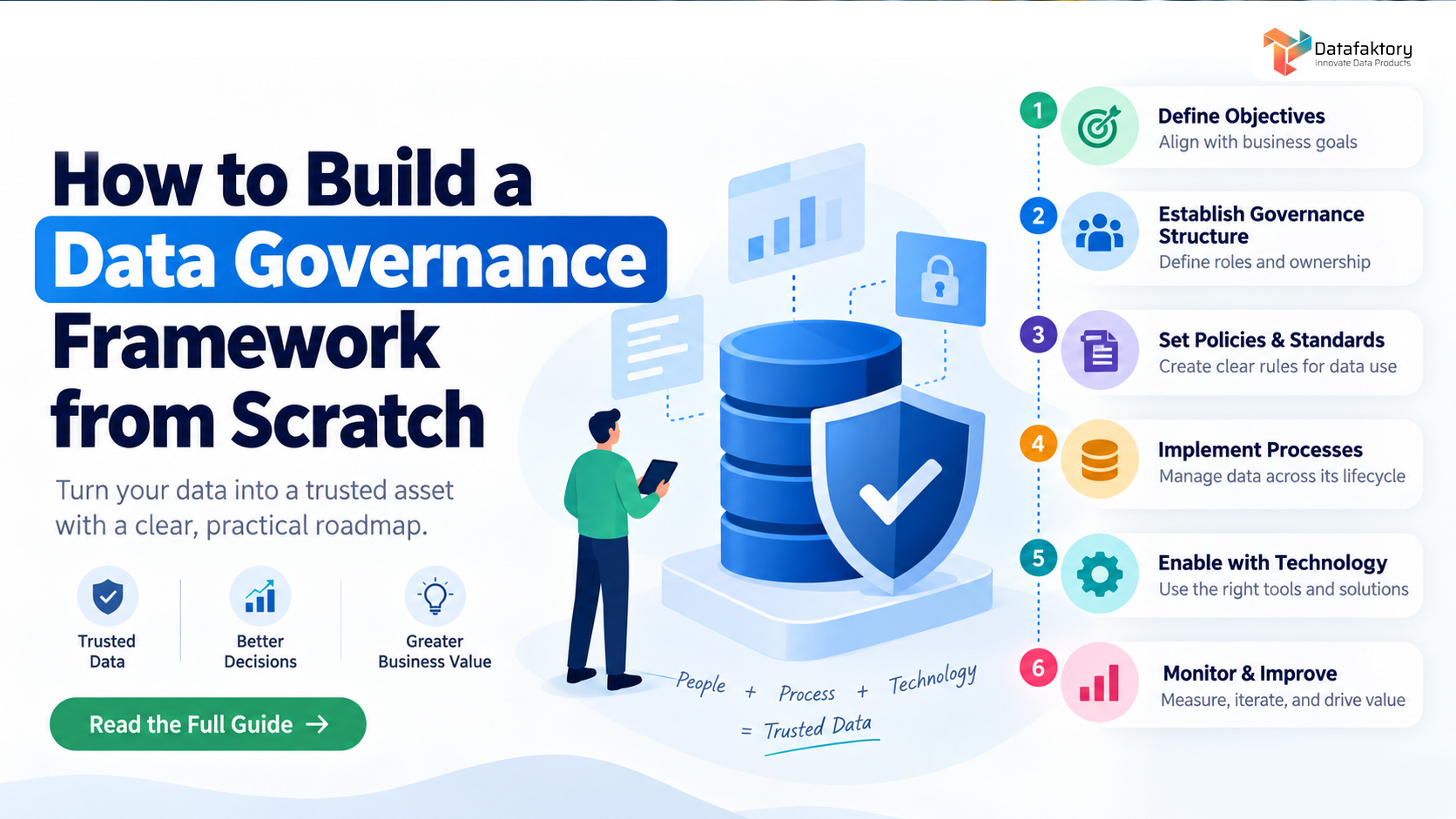
A Data Governance framework is a structured system of policies, roles, standards and processes that defines how an organisation manages, protects and uses its data. It ensures that business data remains accurate, secure, accessible, compliant and ready for analytics and artificial intelligence.
Building Data Governance from scratch may appear complex. However, a practical and phased approach can make its implementation manageable, measurable and aligned with business goals.
1. Define Your Data Governance Objectives
Begin by identifying why your organisation needs Data Governance. Common objectives include improving data quality, meeting regulatory requirements, reducing security risks, enabling trusted reporting and preparing data for AI initiatives.
Connect every objective to a measurable business outcome. For example, improving customer data accuracy can support better personalisation, while governing operational data can strengthen forecasting, production planning and decision-making.
Clear objectives will help stakeholders understand that Data Governance is not only an IT initiative but also a business transformation programme.
2. Assess Your Current Data Environment
Conduct a data maturity assessment to understand how data is currently collected, stored, processed, accessed and shared across the organisation.
The assessment should identify:
- Critical data sources and systems
- Data quality and consistency issues
- Existing security and access controls
- Regulatory and compliance gaps
- Duplicate or disconnected datasets
- Data ownership and accountability gaps
This assessment establishes a baseline and helps the organisation prioritise its most important data domains instead of attempting to govern every dataset at once.
3. Establish Clear Roles and Responsibilities
Effective Data Governance requires clear accountability. Create a governance structure that includes executive sponsors, a Data Governance council, data owners, data stewards, IT teams and compliance representatives.
Data owners are accountable for specific data domains, while data stewards maintain data definitions, quality standards and usage rules. A RACI matrix can clarify who is responsible, accountable, consulted and informed for each governance activity.
4. Create Data Policies and Standards
Develop policies covering the complete data lifecycle—from data creation and storage to usage, sharing, retention, and deletion.
Your Data Governance policies should address:
- Data classification
- Data quality standards
- Access permissions
- Privacy and consent
- Metadata management
- Data retention
- Regulatory compliance
- Responsible AI usage
5. Build a Data Catalogue and Business Glossary
A data catalogue provides visibility into what data exists, where it is stored, who owns it and how it can be used. A business glossary establishes consistent definitions for important business terms, metrics and KPIs.
Together, these resources reduce confusion, improve data discovery and create a shared language between business and technical teams.
6. Implement Data Quality and Security Controls
Define measurable data quality rules covering accuracy, completeness, consistency, validity, uniqueness and timeliness. Automated monitoring can identify anomalies and generate alerts before unreliable data affects reports, AI models or business decisions.
Organisations should also implement role-based access controls, encryption, audit trails and privacy-by-design principles to protect sensitive information throughout its lifecycle.
7. Start Small, Measure and Scale
Begin with one high-value data domain, such as customer, supplier, financial or manufacturing data. Track metrics including data quality scores, policy compliance, issue-resolution time and user adoption.
Use the results from the pilot programme to improve your Data Governance framework before expanding it across departments, systems and locations.
Build a Trusted Data Foundation with Datafaktory
Strong Data Governance transforms fragmented information into a trusted foundation for analytics, AI, compliance and scalable decision-making. Datafaktory helps organisations assess governance maturity, establish practical policies and operating models, implement quality and compliance controls and build secure, AI-ready data foundations.
Contact us today to develop a practical Data Governance framework aligned with your business objectives, technology environment and regulatory requirements.