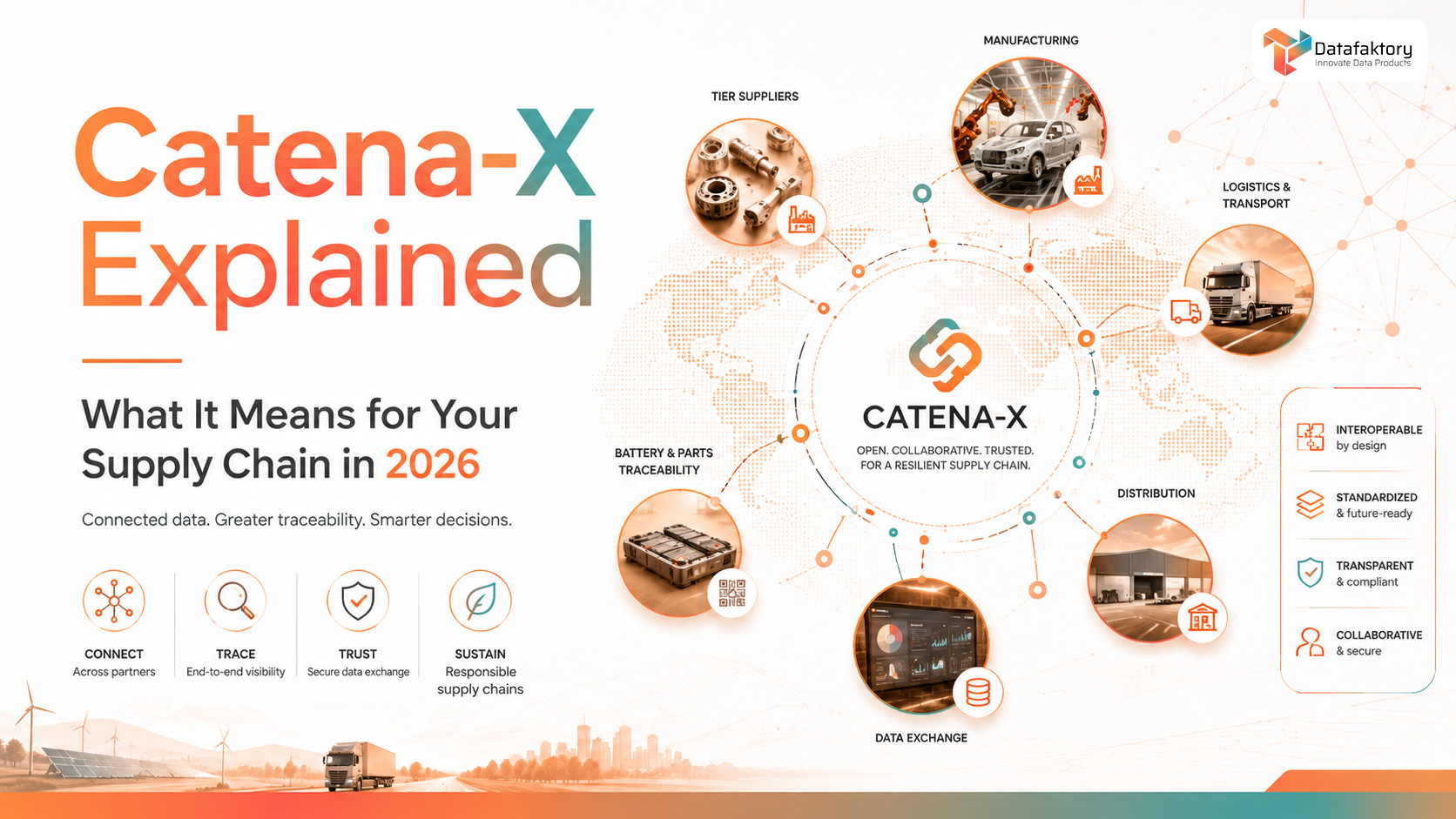
In 2026, automotive supply chains are under growing pressure to become more transparent, connected and data-driven. Catena-X is emerging as an important framework for achieving this by enabling trusted data exchange between manufacturers, suppliers, logistics providers and technology partners.
Catena-X is an open, collaborative data ecosystem created specifically for the automotive value chain. Instead of forcing companies to move all their data into one central platform, it enables participants to exchange selected information through common standards while maintaining control over their own data.
What Is Catena-X?
Catena-X provides a standardized approach for sharing supply-chain information across multiple tiers. Companies can connect data from different systems, partners and processes using interoperable standards and data-space technologies.
This makes it easier for OEMs, Tier 1 suppliers, SMEs and other ecosystem participants to collaborate without creating a new point-to-point integration every time data needs to move between organizations.
For supply-chain leaders, the value is straightforward: better visibility, faster information exchange and more consistent data across the network.
Why Does Catena-X Matter for Supply Chains in 2026?
Supply chains increasingly depend on information that sits outside a company’s own systems. Product traceability, carbon data, quality information, supplier capacity, and component details often need to move securely across several organizations.
Catena-X supports business areas including traceability, sustainability, quality management, master data, and demand and capacity management.
By using standardized data models and interoperable services, companies can reduce fragmented data exchange and create a more reliable foundation for cross-company collaboration.
Its relevance is also becoming increasingly global. In July 2026, Catena-X announced new cross-border automotive data-space infrastructure connecting China and Europe, highlighting the ecosystem’s expanding role in international automotive supply chains.
What Are the Main Business Benefits of Catena-X?
A successful Catena-X implementation can help organizations:
- Improve end-to-end supply-chain transparency
- Exchange information securely while retaining data sovereignty
- Standardize collaboration with OEMs and suppliers
- Improve product and component traceability
- Support Product Carbon Footprint and sustainability use cases
- Reduce manual data exchange and integration complexity
- Build a scalable foundation for future digital supply-chain services
However, connecting to Catena-X is not only a technology project. Companies must identify the right business use case, prepare their data, map existing systems, understand Catena-X standards, and develop an integration architecture that works with ERP, MES, PLM, and supplier systems.
Choosing a Catena-X Partner Switzerland
For manufacturers looking for a Catena-X Partner Switzerland, the starting point should be a readiness assessment. This helps determine which Catena-X use cases can create measurable value, what data needs to be exchanged and where integration gaps exist.
Working with a Catena-X implementation partner in Switzerland can then help turn those requirements into a practical onboarding, data integration, and implementation roadmap.
Datafaktory supports Catena-X implementation in Switzerland, helping automotive and industrial manufacturing organizations prepare for Catena-X and exchange supply-chain data with ecosystem participants, including OEMs and Tier 1 partners.
How Should Your Business Get Started?
Start with one high-value use case rather than attempting to transform the entire supply chain at once. Assess your data readiness, partner requirements, integration architecture, and compliance needs, then create a phased roadmap.
Explore Datafaktory’s Catena-X Implementation services to understand how your organization can move from Catena-X readiness to secure, scalable participation in the automotive data ecosystem.