
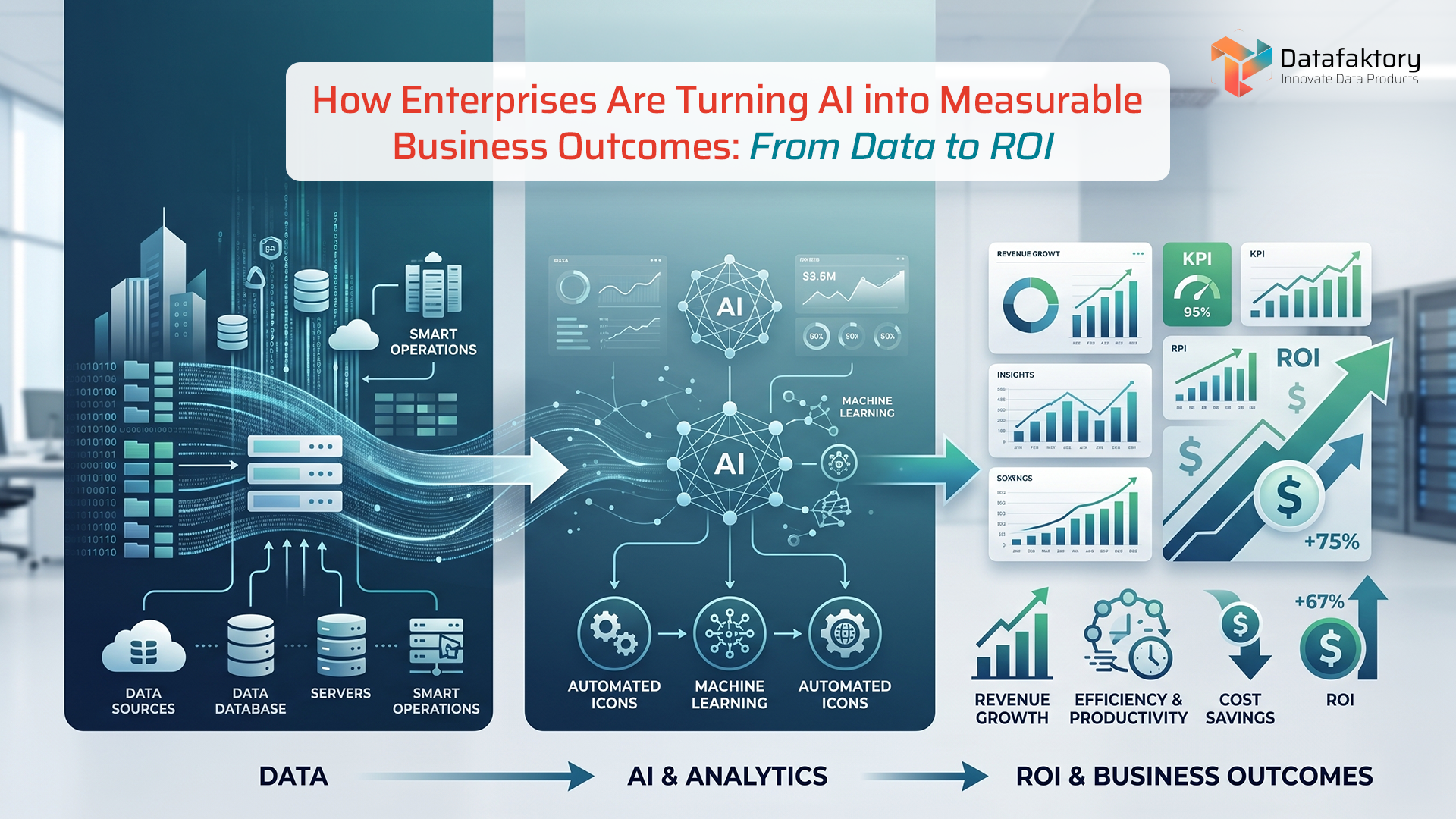
Artificial Intelligence is no longer experimental — it’s expected to deliver real, measurable business impact. Yet many enterprises still struggle with a key challenge: How do you translate AI into ROI?
The answer starts with shifting perspective. AI is a business transformation tool.
Successful organizations don’t begin with algorithms. They begin with
This is where enterprise AI becomes powerful — when it is tightly aligned with outcomes.
The next step is enabling AI-driven decision making. Instead of relying on static reports, businesses are embedding AI into workflows:
What separates leading enterprises is their ability to measure AI ROI effectively.
They do this by defining clear metrics upfront:
For example, an AI model that improves demand forecasting isn’t just “accurate” — it directly reduces stockouts and excess inventory, translating into measurable financial gains.
Another critical factor is data readiness. AI is only as good as the data behind it. Enterprises investing in clean, accessible, and well-governed data are far more likely to see ROI.
Finally, scalability matters. Many AI initiatives fail because they remain stuck in pilot mode. Leading companies focus on:
The result? AI moves from being a cost center to a revenue driver.
In the end, the journey from data to ROI isn’t about more models — it’s about better alignment between data, AI, and business value.
Digital transformation is the process of using digital technologies, data, automation, and AI to improve how a business operates, serves customers, and grows. It is about fundamentally changing how an organization works, makes decisions, manages information, and creates long-term value.
A consulting partner helps companies move from technology confusion to practical business outcomes. They study existing processes, identify improvement areas, and recommend digital solutions aligned with business goals.
A digital transformation assessment is a structured review of a company’s current digital maturity. It evaluates how effectively the business uses technology, data, workflows, automation, and digital systems across departments
Digital transformation helps businesses automate repetitive tasks, improve productivity, leverage real-time data, and deliver better customer experiences — while enabling leadership to make faster, data-backed decisions.