Industrial transformation rarely fails because organisations lack ideas. It usually slows because teams pursue separate priorities, technology investments are disconnected from business outcomes, and leadership lacks a shared view of what should happen first. An industry readiness assessment creates an evidence-based starting point for a practical digital transformation roadmap.
What Is an Industry Readiness Assessment?
An industry readiness assessment is a structured evaluation of an organisation’s ability to execute digital transformation. It examines strategy, processes, technology, data, workforce capabilities, governance and performance management.
The objective is not simply to assign a maturity score. It is to identify capability gaps, clarify priorities and determine which initiatives are valuable and achievable.
The National Institute of Standards and Technology, or NIST, explains that its Smart Manufacturing Systems Readiness Level framework evaluates organisational maturity, IT applications, performance and information connectivity. These findings can then support customised factory improvement planning.
Why Does Strategy Drift Happen?
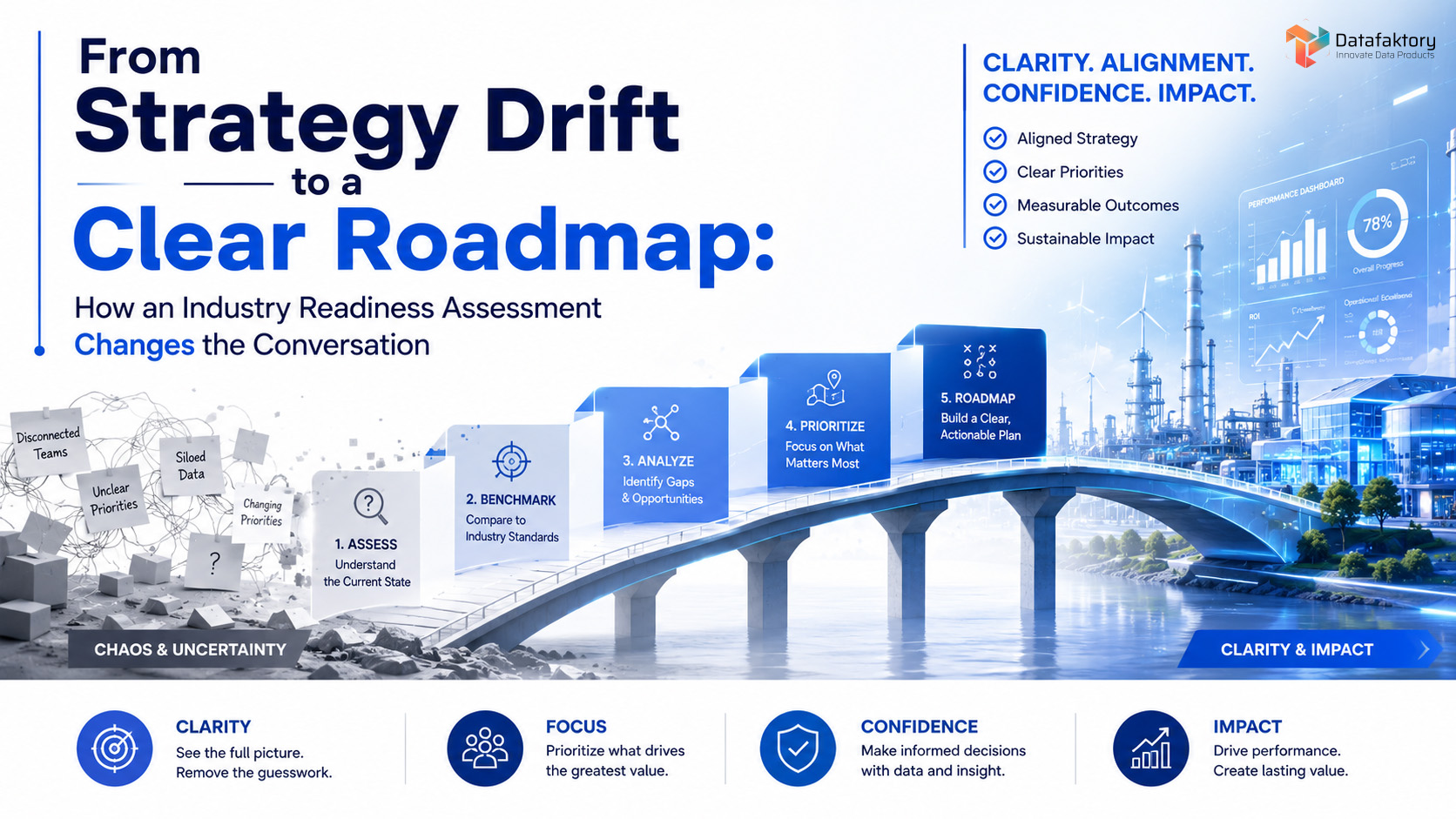
Strategy drift begins when transformation initiatives lose their connection to measurable business needs. One team may prioritise artificial intelligence, another automation, while operational leaders remain concerned with downtime, quality, energy use or delivery performance.
Without a common assessment, each function may advocate for its preferred solution. This can create disconnected pilots, duplicated investments and projects that cannot scale.
The OECD identifies limited awareness, internal resources, skills and financing as persistent barriers to SME digitalisation. Switzerland’s federal SME portal similarly recommends evaluating the organisation, technologies and resources before deciding which tools, machines and skills are required for digital transformation.
How Does an Assessment Improve Leadership Decisions?
A readiness assessment moves the discussion from “Which technology should we buy?” to “Which business capability should we strengthen?”
It gives executives, operations teams and technology specialists a shared fact base. Stakeholders can review specific gaps such as inconsistent production data, unclear ownership, disconnected systems, limited digital skills or weak governance.
Leadership can then prioritise initiatives according to business impact, feasibility and readiness. The assessment also separates quick wins from foundational work that must be completed before advanced solutions can deliver value.
What Should a Clear Transformation Roadmap Include?
A useful roadmap translates assessment findings into outcomes, owners, timelines, and performance indicators. Each initiative should connect to a business goal and fit within realistic implementation phases.
Predictive maintenance, for example, may offer significant value, but it will not succeed if equipment data is incomplete or maintenance processes are inconsistent. The roadmap may therefore begin with sensor coverage, data standardisation, process ownership and workforce training before advanced analytics is introduced.
This sequencing reduces implementation risk and ensures technology is supported by the people, processes and data required for sustainable value.
From assessment to roadmap
The output that matters isn’t the score — it’s the roadmap that follows it. A useful assessment translates maturity gaps into a prioritized, phased plan: what to fix first (usually foundational data and governance issues), what to build next (the highest-value, most feasible use cases given current constraints), and what capabilities the organization needs to build to sustain progress without permanent reliance on external partners.
This is the structure behind our own engagement model — Engage (assess), Envision (roadmap), Engineer (build), Empower (sustain) — and it starts, deliberately, with assessment rather than architecture. You can’t design a target state you haven’t honestly measured the distance to.
Turning drift into direction
If your organization recognizes itself in the strategy-drift description — multiple initiatives, unclear priority, no shared reference point — that’s the signal to pause and assess before funding the next pilot.
Our AIMRI (Industry Maturity Assessment) is designed to produce exactly that shared baseline: a clear, evidence-based view of where your organization stands today and a prioritized roadmap for what comes next.
Get in touch about an AIMRI assessment and give your organization one shared picture to plan from.