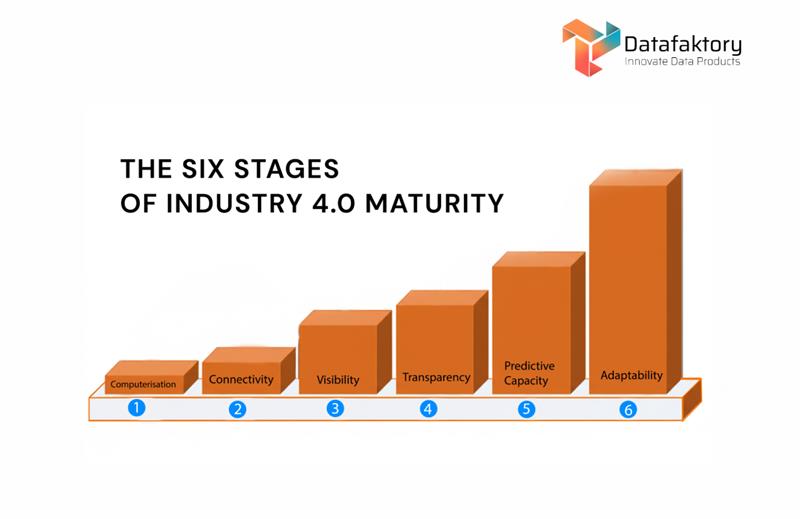
Most comprehensive maturity models identify six distinct stages in the industry 4.0 journey:
Basic digitalization with standalone systems and isolated data islands. Most legacy manufacturers start here.
Systems begin talking to each other. Data flows between previously isolated processes, creating the foundation for integrated operations.
Real-time monitoring and visualization capabilities emerge. You can see what’s happening across your operations, but you’re still primarily reactive.
Advanced analytics provide insights into why things happen. Root cause analysis becomes data-driven, and patterns emerge from historical data.
Machine learning and AI enable you to anticipate problems before they occur. Maintenance becomes predictive, and optimization becomes proactive.
Full autonomy and self-optimization. Systems adapt to changing conditions automatically, and your manufacturing processes become truly intelligent and resilient.
Understanding maturity also means recognizing that different Industry 4.0 technologies follow distinct adoption patterns:
Technologies like IoT sensors and basic data analytics might already be in the routinization stage for many manufacturers, while advanced AI applications and autonomous systems are still in the intention or early adoption phases.
Industry 4.0 maturity models serve three critical purposes:
Without this structured approach, many manufacturers fall into the “pilot purgatory” trap—running endless proof-of-concept projects without achieving scalable, enterprise-wide transformation.
The most successful Industry 4.0 transformations take time. They follow a deliberate, measured approach:
Before implementing AI or advanced analytics, ensure you have reliable data collection and basic connectivity in place. You can’t build a smart factory on a shaky digital foundation.
Identify specific business problems that digital technologies can solve. The goal isn’t to be cutting-edge — it’s to be profitable and efficient.
Technology transformation without people transformation fails. Invest in training, change management, and creating a culture that embraces continuous learning.
Use maturity assessments regularly to track progress, identify gaps, and adjust your strategy. Digital transformation is a journey, not a destination.
Companies that successfully navigate Industry 4.0 maturity don’t just survive disruption—they drive it. They become more agile, more efficient, and more responsive to market changes. During recent global disruptions, digitally mature manufacturers didn’t just maintain operations; they gained market share.
Digital transformation is the process of using digital technologies, data, automation, and AI to improve how a business operates, serves customers, and grows. It is about fundamentally changing how an organization works, makes decisions, manages information, and creates long-term value.
A consulting partner helps companies move from technology confusion to practical business outcomes. They study existing processes, identify improvement areas, and recommend digital solutions aligned with business goals.
A digital transformation assessment is a structured review of a company’s current digital maturity. It evaluates how effectively the business uses technology, data, workflows, automation, and digital systems across departments
Digital transformation helps businesses automate repetitive tasks, improve productivity, leverage real-time data, and deliver better customer experiences — while enabling leadership to make faster, data-backed decisions.